Saturday, February 25, 2012

Community Forest & State Forest

A history of forests in Indonesia began in the 18th century by the Dutch. The system adopted from European countries (Germany). The system is trying to manage forests to meet the growing needs of carpentry. In this case using a monoculture which will then be harvested entirely at any given time.
Logging system is planned from the beginning and the types are commercial trees with economic goals. Plantations have a weakness for the rest of ecological terms. Contonya land on Java was initially not so good, and then rehabilitate the community to resolve the issue. They use the land to be able to cope with economic problems. Another example is the forest in Central Java can be harvested with the results of more than 10 million rupiah per m2 every 15 years. Results are harvested by people in the last year and people can take the benefits. In the national forests are encouraged to improve the country's economy.
In this case although the state forests managed by the state, but now the public can access the country's forests, as this is done to obtain cheap labor in managing the forest.
For example, the forest around Yogyakarta Wanagama ecological situation is better than the state forest, because the vegetation is diverse and not rest. The condition of standing crops tend to be meeting with teak (Tectona grandis), Acacia (Accacia auriculiformis), Eucalyptus (Eucalyptus sp.), Mahogany (Switenia macrophylla), elephant grass, etc.. Among the vegetation are the most dominant oak because it is often needed and is adapted to the needs of the community in the future.
Farming culture adapted to the forest by the needs of the community, so not very big consequences for the ecosystem (negative result). The forests are also using the system for the results, which means the management of shared and enjoyed together the results produced citizens who manage it. Forest conditions compared to the state forest if the review on the ecological aspects of forests has a diversity of plant species that have a variety of functions. Agroforestry systems are known which have the advantages of wood-producing plants (commercial), food producers, and livestock feed. Besides the customized needs of harvesting system and no plants age, the ecological conditions are also maintained. And in addition also the needs of the societies can be fulfilled. While the condition of the state forests, state forests are planted with forest / trees kind and most of the rest and pemanenanya thoroughly. So adequate well functioning economy, while ecological conditions will be damaged.

Monday, January 2, 2012

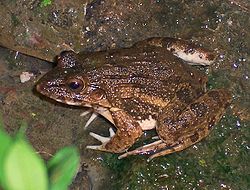
Fajervarya cancrivora in The Bowl

    Soup is identical to cook vegetables or meat into a large skillet with additional broth and spices. There are different with this soup, so this soup is a soup or toad that is often called swike. Swike actually is Chinese cuisine, indeed swike using toad meat ingredients but today most people use the chicken to the material. Type of toad that is often used for rice paddies is a toads swike (Fajervarya cancrivora). This type is used because this toad does not have poison glands in their bodies.
     Toad is a type of rice that many live toads in the rice paddies, swamps, ditches and sewers, to the mangrove swamps. Fejervarya cancrivora scientific name, and in English is known as the marsh toad, rice-field toad or crab-eating toad; last name is given because it preys craze frog crab paddies (Lat. cancer crab, vorare eat, prey).The Javanese call it a green toad, because many of them are colored green. Name of other areas that include toads and bangkong china.
     Toads are small to rather large stature, stocky, with strong legs and muscular thighs are huge. Adult males about 60 mm and adult females about 70-80 mm; but the largest can be up to 120 mm SVL (snout to vent length, from snout to anus). Small specimens rather difficult to distinguish from the moor toad (F. limnocharis).Back brownish-colored mud, with dark blotches are not symmetrical. Sometimes there is a bright green moss on large specimens. Side of the body and groin with dark patches. Hands and feet are often streaky-streaked. Black striped lip.
    There are thin folds of skin extending over the back, similar to nodule lines or ridges. Feet with a full membrane pool to the ends of fingers, toes except the fourth. Metatarsal single nodule, located on the inside (the base of the first finger) feet, elongated shape.
     Toads are often found in marshy areas, especially near the man-made environment: the muddy garden, rice fields, water channels; but rather rare in the river. Also is the only kind of modern amphibian that can live in brackish water areas and mangrove forests.
    Most active in the dark and early morning, at noon this toad hiding behind grass or cracks in the embankment or cliff water channels, and suddenly jumped into the water when going trampled. At night, especially after the rain fell, the sound of toads calling male-female sound of the water's edge: ... dododododok .. dododok, with a fast rhythm. But instead of sounds together, male toads are inter-outs. Similar is the case with the stone toad (Limnonectes macrodon), this frog is often sought after to take her thighs are fat, to be used as cooking swike (Swie kee, chicken water) tionghoa delicious at the restaurant.
     Toad is widespread fields ranging from Indochina, Hainan, Malay Peninsula to the Philippines, Borneo, Sulawesi and East Nusa. These toads also terintroduksi to Papua.
      Swike was delicious but we must remember that not too much to eat. Recent research suggests that in bone and meat containing tapeworm toad is the same thing with pork. If meat is not thoroughly cooked and is feared if the tapeworm eggs is not dead. When ingested would interfere with the digestive process because it hangs tapeworm in the small intestine and will absorb the juices of the food so the body becomes malnourished. We must also remember that many people out there who do not eat frog meat, then respect them.

Saturday, December 24, 2011

Rangifer tarandus Pulling the Santa Claus's Sleigh


Remember to Santa's Sleigh? What animal is running the sleigh? Yes, the animal is a reindeer or caribou often called.
The reindeer (Rangifer tarandus), also known as the caribou in North America, is a deer from the Arctic and Subartic, including both resident and migratory populations. While overall widespread and numerous,some of its subspecies are rare and one (or two, depending on taxonomy) has already gone extixnt. Reindeer vary considerably in color and size. Both sexes grow antlers, though they are typically larger in males. There are a few populations where females lack antlers completely. Wild reindeer hunting and herding of semi-domesticated reindeer (for meat, hides, antlers, milk and transportation) are important to several Arctic and Subarctic people.Even far outside its range, the reindeer is well known due to the myth, probably originating in early 19th century America, in which Santa Claus's sleigh is pulled by flying riendeer, a popular secular element of Christmas.In Lapland, reindeer pull pulks. Do you believe in Santa Claus? It's a complicated question. But most important of all is that we can imitate the actions of Santa with joy and love to give gifts to children. Just as the love of Jesus that He gave to us. JBU and Merry Chrismast :D

Pine Fruit (Pinus merkusii) on Christmas Tree Ornament

       Pinus merkusii is a plant native forest in the mountains. This tree is a plant Conifer (needle-leaved), which has strands of vesicles at the base of the leaves, evergreen, called a cone whose height can be up to 30 m more, no buttress roots, bark furrowed deep, cone-shaped (conus) fruit and has the two winged seeds, as well as the direction of branching ortotroph until sympodial. This we know gymnosperms trees have different types of functions. As usual the wood can be used as a matchstick, furniture and building materials, pulp and paper. The sap out of the wood in the form of resin from the sap of these products named Gondorukem. Gondorukem is normally used for cosmetics, mix paint, etc..     
      Christmas was almost upon every people around the world who celebrate it most definitely is preparing for the Christmas tree. Whether it's a Christmas tree from branches / spruce or plastic Christmas tree. Most of them said if there was no Christmas tree, Christmas is less waaahh. One of the decorations for Christmas trees are often used are properties of plastic because it is easily obtained and inexpensive. But there also are using Christmas tree ornaments from pinecones. Pine has been popular since ancient generally used European and American society in celebrating Christmas. They arranged it with pear leaves and cerry fruits, usually ornament is hung on the door leaf or a Christmas tree. Now is also a pine also often used in decorations for Christmas trees is now even more creative. As example fruit is there a painted pine and formed something of interest. It could be the fruit of this pine became a small business that is profitable. Christmas trees are also accompanied by a colorful LED light that displays the holy beauty beautiful night.      
     Lots of Christmas tree ornaments, just like our hearts when adorned by love Christmas then it becomes complete. Christmas not memorable and doesn't mean if without love, realize love for each person you are sincere, heartfelt giving, generous, and forgiving one another the same as the love of Christ to us. Christmas is a day full of joy and peace, create the fruit of the spirit. Happy Christmas and welcome the new year friends. The grace of the Lord Jesus be with you all. JBU ^ _ ^

Mangrove Land Degradation

          As we know that Indonesia is the largest archipelago country in the world with 18 000 islands both inhabited or not. Not uncommon along the lip or the coastal mangrove forest area is found. Mangrove forest is the vegetation that grows between tide lines. The difference with coastal forests, areas that are along the edge of the sea and generally have sand or soil structure sometimes geluhan sand, which is strongly influenced by tides. Mangrove forests are generally scattered throughout the territory of Indonesia. Mangrove plants are multifunctional and also a lot of benefit to biodiversity of a place. Indicating the existence of mangrove forest area is still clean and natural. Mangrove Forest Ecology very big impact for the life-marine biota as well as around it. Mangrove A simple example can be used as habitat for shore birds, fish and crustaceans. Another benefit is even mangrove mangroves can absorb CO2 in the air effectively, lowering the temperature (to prevent global warming), breaking waves, preventing abrasion and lowered sea level. Vegetation consists of mangrove forests that make it up-vegatasi among others, from family Avicenniaceae, Sonneratiaceae, Rhizophoraceae, and Aracaceae.        
       Mangrove forest ecosystems have ecological functions, economic and social importance in development, particularly in coastal areas. However, the condition of mangrove forests in Indonesia continues to experience widespread damage and reduction of the speed of damage reached 530 000 ha / year.While rate of addition of the total area of ​​mangrove rehabilitation can be realized is still much slower than the rate of damage, which is only about 1973 ha / year. Similarly, the condition of mangrove forest in West Sumatra is only 4.7% is good, while 95.3% in damaged condition. Therefore, the necessary efforts to restore degraded mangrove forest in order to return to their function for human welfare and support the development of coastal areas. Increased awareness and public knowledge about the importance of the existence of mangroves in supporting the economic life of coastal communities need to continue to be encouraged. Community participation in mangrove rehabilitation and management can be the key to the success of mangrove conservation. These efforts must be accompanied by an increase in public welfare, for example through the activities silvofishery, harvesting (such as: wood, palm sap, mud crab, mangrove oysters, etc.) as well as sustainable tourism development. Issue a tsunami can be a trigger to encourage re-rehabilitation of damaged mangrove forest on the west coast of Sumatra in order to reduce the damaging effects of the tsunami, given the west coast of Sumatra is a path that could potentially cause a tsunami earthquake.

MUSIM BERGANTI BURUNG FLYWAY


Secara garis kathulistiwa bumi dibagi menjadi dua belahan yaitu belahin bumi utara dan selatan. Di belahan bumi utara bersuhu dingin , beriklim subtropis / tundra, kelembapan rendah dan memiliki 4 musim (spring, summer, autumn & winter).
Pada musim gugur (autumn) dan musim dingin (winter) ini digunakan burung migran untuk bermigrasi ke tempat yang lebih hangat. Sebagaimana kita ketahui bahwa di belahan bumi selatan beriklim tropis, bersuhu hangat, kelembapan yang tinggi, dan mempunyai 2 musim (kemarau & penghujan). Migrasi itu sendiri adalah perpindahan yang dilakukan secara soliter atau kelompok ke suatu wilayah tertentu untuk melakukan kegiatan-kegiatan seperti breeding, mencari makan, dan mencari daerah territorial baru. Migrasi telah dilakukan oleh burung-burung migran sepanjang tahun, dan migrasi ini biasanya disertai dengan flyway.

APA ITU FLYWAY ?
Keseluruhan wilayah yang secara periodik dilalui oleh burung-burung migran dalam pergerakan migrasinya, dari breeding ground ke non breeding areas, termasuk daerah persinggahan yang menjadi tempat istirahat dan mencari makan disepanjang rute perpindahannya. Jalur flyway burung migrant dibagi atas 9 wilayah di dunia diantaranya: Atlantic Americas Flyway, Black Sea/Mediterranean Flyway, Central Asian Flyway, East Asian-Australasian Flyway, East Atlantic Flyway, Mississippi Americas Flyway, Pacific Americas Flyway,& West Asian-East African Flyway.


informasi gambar: http://www.eaaflyway.net


Dapat kita lihat di atas bahwa Indonesia dilalui jalur East Asian-Australian Flyway yang memiliki jalur migrasi dari Rusia Timur jauh dan Alaska kearah selatan melalui Asia Timur dan Asia Tenggara hingga Australia dan New Zeland. Pada wilayah flyway mencakup sebanyak 22 negara (hempir separuh penduduk dunia): USA, Rusia, Mongolia, China, Korea Utara, Korea Selatan, Jepang, Filipina, Vietnam, Laos, Kamboja, Thailand, Myanmar, Bangladesh, Malaysia, Brunei, Singapore, Indonesia, Timor Leste, PNG, Australia, dan New Zealand.
Potensi dan Ancaman
Potensi EAAF (East Asian-Australian Flyway) dihuni oleh sedikitnya 50 juta burung air migran dari 250 kelompok populasi yang berbeda, dimana 28 jenis diantaranya terancam secara global. Kelompok burung yang secara periodik bermigrasi hingga melintasi batas wilayah negara dalam jumlah yang relatif banyak contohnya seperti jenis burung penyelam, grebes, cormorants, strom petrels, sheawaters, heron, pelican, bangau, camar, angsa, ibees, spoonbill, raptor, dll. Sebanyak 700 site telah diidentifikasi sebagai daerah persinggahan burung migran. Ancaman burung-burung migran dan habitatnya meliputi: hilangnya habitat melalui reklamasi lahan basah dan hutan, hilangnya habitat karena penginfestasian pertanian, degradasi habitat melalui polusi, pengangguran atau pengalihan pasokan air, peningkatan gangguan manusia, tanaman invasive dan predator, serta perubahan iklim. Ancaman – ancaman ini dapat dicegah apabila kita mau untuk ikut serta melestarikannya. Mulai dari cara yang sederhana saja seperti tidak merusak habitat, menghentikan kegiatan perburuan, dan tidak ikut berpartisipasi dalam komersialisasi (penjualan/pembelian) satwa-satwa liar yang dilindungi khususnya pada burung. Karena burung termasuk bagian dari rantai makanan yang berpengaruh penting bagi keberlangsungan kehidupan dan kelestarian pada ekosistem /lingkungan makhluk hidup.
Ark’11

BIRD MARKING: Nisaetus cirrahtus Pusat Penyelamatan Satwa Jogja


Elang Brontok/Hawk-eagle: Nisaetus cirrahtus
Deskripsi:Berukuran besar (70cm), bertubuh ramping. Sayap sangat lebar, ekor panjang berbentuk bulat, jambul sangat pendek. Terdapat fase gelap pucat, dan peralihan. Fase gelap: seluruh tubuh cokelat gelap dengan garis hitam pada ujung ekor, terlihat kontras dengan bagian ekor lain yang cokelat dan lebih terang. Burung muda juga berwarna gelap. Fase terang: tubuh bagian atas cokelat abu-abu gelap, tubuh bagian bawah putih bercoret-coret cokelat kehitaman memanjang, setrip mata dan kumis kehitaman. Burung muda: tubuh bagian atas cokelat keabu-abuan, kepala dan tubuh bagian bawah keputih-putihan. Bentuk peralihan di antara kedua fase tadi terutama terlihat pada pola warna coretan dan garis (tetapi lebih mirip bentuk terang): garis-garis hitam pada ekor dan sayap tidak teratur serta garis-garis cokelat kemerahan melintang pada perut bagian bawah, paha, dan ekor bagian bawah. Iris kuning sampai coklat, paruh kehitaman, serta kuning kehitaman, kaki kuning kehijauan.
Suara: Pekikan panjang “kwip-kwip-kwip-kwip-kwiiah” meninggi atau “klii-liiuw” tajam
Penyebaran global: India, Asia tenggara, Filipina. Sunda Besar dan Nusa Tenggara.
Penyebaran local dan Status: Terdapat di seluruh dataran Sunda Besar, tidak umum ditemukan di bawah ketinggian 2000 m.
Kebiasaan: Mengunjungi hutan dan daerah berhutan yang terbuka, menyergap ayam kampong. Berburu dari udara atau dari tempat bertengger di pohon kering. Umumnya berburu di hutan yang baru ditebang.

Elang Brontok di PPSJ
PPSJ merupakan tempat penyelamatan satwa yang dilindungi di Kulon Progo Yogyakarta. Umumnya satwa-satwa tersebut hasil sitaan dari perburuan dan serahan dari warga dan mereka semua dilindungi Undang-Undang. Satwa-satwa tersebut antara lain elang, burung hantu, burung kakatua, nuri,beruk, owa, bahwan orangutan. Oktober 2011 Elang Brontok di PPSJ ini merupakan hasil sitaan petugas BKSDA dari perdagangan di pasar-pasar hewan Yogyakarta. Karena elang ini hasil sitaan, maka tidak dapat langsung dilepas liarkan begitu saja. Elang pertama kali harus direhabilitasi, dilakukan medical check up, wing marking, habituasi, realease, dan monitoring. Dalam hal ini elang brontok ini dilakukan medical check up dan wing marking. Dalam medical check up burung diperiksa kondisi tubuhnya. Pemeriksaan dimulai dengan pengukuran bagian tubuh elang seperti panjang paruh, rentang sayap, panjang cakar, mata, dll.

Baru kemudian dilakukan pemeriksaan darah agar mengetahui bahwa elang tersebut layak untuk dilepaskan atau tidak. Setelah dilakukan hal-hal di atas maka kemudian burung elang dipasang wing marker, umumnya wing marker bewarna mencolok. Wing marker ini berfungsi untuk mempermudah kita saat me-monitoring elang tersebut. Elang Brontok ini belum bisa di tempatkan ke dalam kandang habituasi karena kondisinya belum optimal, maka untuk sementara elang ini di tempatkan di kandang rehabilitasi dahulu, baru 2/3 bulan setelah itu elang baru ditempatkan di kandang habituasi. Kandang Habituasi diusahakan agar jangan terlalu sering dilihat atu didekati manusia karena dikhawatirkan elang sulit untuk beradaptasi dan menjadi ketergantungan pada manusia. Elang Brontok ini akan di tempatkan di kandang habituasi selama 1 atau 2 minggu dan makanannya telah disuplai oleh petugas selama masih di kandang. Kandang habituasi ini ditempatkan di Suaka Marga Satwa Waduk Sermo Kulon Progo Yogyakarata karena lokasi ini dianggap cukup tepat untuk melepaskan elang nantinya. 


MacKinnon, J., K. Phillipps, B.V. Balen. Burung-burung di Sumatera, Jawa, Bali dan Kalimantan.2010.  LIPI. Bogor